Understanding the Build-Up on San Antonio Homes
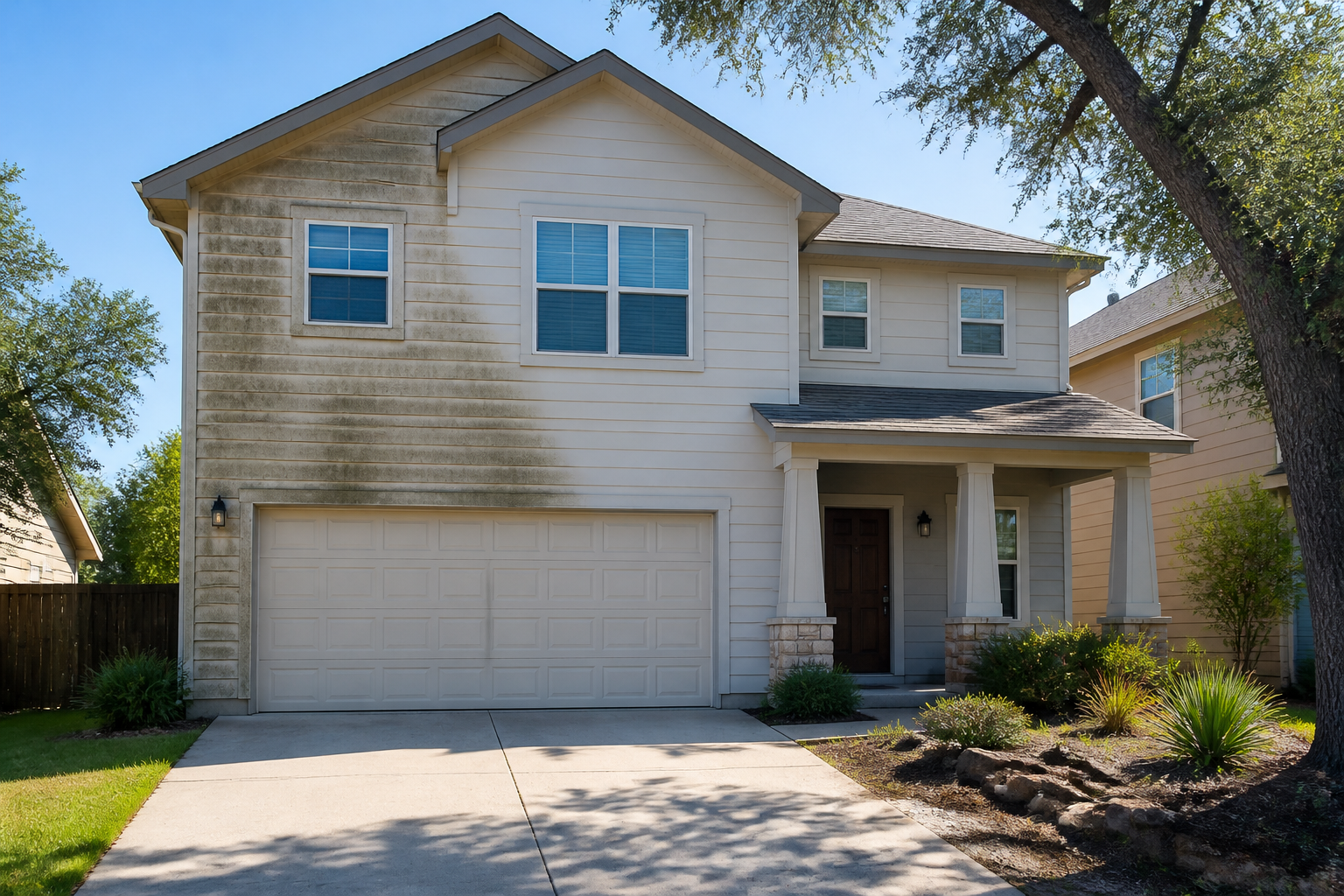
If you take a walk around your home, especially on the north-facing walls or shaded corners of your driveway, you will likely spot dark discoloration. Some spots look like dark soot smeared across the siding. Other areas show a distinct, slimy green film creeping over the foundation or between concrete expansion joints.
Many homeowners assume these marks are simply road dust, engine exhaust, or Texas topsoil blown in by seasonal winds. That is rarely the case. In most instances, those stains are living organisms feeding on ambient moisture, dust, and minerals.
Living with algae on siding in San Antonio is an everyday reality because of our climate. We deal with intense summer heat, sudden downpours, and high humidity levels in spring and autumn. When moisture settles against exterior building materials without receiving direct afternoon sun, biological growth takes root.
Ignoring the issue does not make it go away. As spores spread, they trap additional moisture against the building envelope and concrete surfaces. Removing them requires knowing what you are dealing with and choosing the right cleaning method so you do not cause surface damage.
What Are Those Green and Black Streaks?
Exterior discoloration generally falls into a few distinct categories. Identifying what is growing on your home helps explain why a simple rinse with a garden hose never gets the job done.
Green Algae
Green growth is typically green algae or early-stage moss. Algae thrive in areas that stay damp and receive limited sunlight. You will frequently see it on:
- North-facing vinyl or fiber cement siding
- The shaded base of brick and limestone facades
- Driveways and patios tucked beneath live oak canopies
- The damp side of detached garages and sheds
Algae spread via airborne spores. Once they land on a surface that holds moisture, they multiply rapidly. While algae are not immediately destructive to structural integrity, the film creates a slippery surface on walkways and gives your exterior an unkempt, weathered appearance.
Black Streaks: Gloeocapsa Magma, Mold, and Mildew
Dark brown or black discoloration often points to Gloeocapsa magma, a hardy airborne cyanobacteria, or colonies of mold and mildew.
- Gloeocapsa Magma: This bacterium develops a dark, protective sheath to shield itself from harsh ultraviolet rays. That dark pigment is what you see staining siding, gutters, and concrete flatwork. Because it protects itself against sun exposure, high Texas temperatures do not dry it out or kill it off.
- Mold and Mildew: Mold tends to look darker, patchy, and slightly fuzzy, whereas mildew often appears flat and powdery before darkening. Both require organic matter and moisture to grow. Dust, pollen, and lingering storm grime resting on your siding provide plenty of food.
Left unaddressed, mold and mildew can work their way behind loose siding panels, work into porous concrete pores, and produce unpleasant musty odors near entryways.
Why Texas Weather Makes the Problem Worse
San Antonio weather is notoriously tough on home exteriors. Our conditions create ideal incubators for mold and algae on siding in San Antonio:
- Severe Thunderstorms and Hail: Texas storm fronts drop inches of rain in a matter of hours. Water splashes dirt and organic debris up against the bottom two feet of siding and soaks flat concrete.
- High Humidity Levels: Even when it does not rain, morning dew and humid Gulf air keep exterior walls damp until well past midday.
- Extreme Solar Heat: While the sun bakes south- and west-facing walls dry, shaded areas remain damp. The temperature difference between sunny and shaded walls promotes condensation, feeding microbial colonies.
When you combine shade from mature trees with heavy seasonal rain, siding and flatwork rarely dry completely. The spores continue to cycle, expand, and darken year after year.
Why Blasting It Yourself Can Cause Costly Damage
When homeowners notice dark stains, the natural reaction is to rent a commercial pressure washer or buy a high-powered unit from the local hardware store. The thought is simple: turn the pressure up and blast the black film away.
This approach often causes permanent damage to exterior surfaces. High-pressure washing without proper calibration leads to several common problems:
Blown Siding and Water Intrusion
Vinyl, aluminum, and fiber cement siding are designed to shed falling rain, not resist water fired upward at 3,000 pounds per square inch. High pressure forces water behind the siding panels, soaking the underlayment, insulation, and wooden wall studs. This creates hidden rot and mold growth inside your wall cavities.
Surface Etching and Chipped Paint
Blasting siding strips away paint layers and permanently scores softer materials. On stucco and brick, excessive pressure blows out the aggregate and degrades mortar joints. Once the outer protective finish is compromised, moisture penetrates deeper into the wall assembly.
Wand Marks on Concrete
Concrete looks virtually indestructible, but top-layer cream can be gouged easily. Using a narrow, high-pressure tip on driveways produces visible swirl lines and zebra stripes. These gouges expose the rough aggregate underneath, making the concrete more porous and prone to collecting deeper stains in the future.
How Professional Pressure Washing Removes Stains Safely
Safe exterior cleaning comes down to technique, appropriate detergents, and controlled water volume rather than sheer mechanical force. This is where professional pressure washing makes a critical difference.
Low-Pressure Soft Washing for Siding
For vertical surfaces like siding, stucco, and trim, professional technicians use a soft washing method. Soft washing relies on dedicated cleaning solutions delivered at low pressure—roughly equivalent to the force of a garden hose.
- Targeted Application: The cleaning solution is applied evenly across the siding to penetrate and break down algae, bacteria, and mold spores at their root level.
- Dwell Time: The solution sits on the surface to dissolve the organic matter and loosen atmospheric dirt.
- Gentle Rinsing: Technicians rinse the surface using high water volume and low pressure, washing away the dead spores and residue without stressing seams, caulking, or paint.
Because the biological growth is neutralized rather than simply scraped across the wall, surfaces stay clean far longer than they do after an abrasive water-only blast.
Flatwork Cleaning for Concrete and Pavers
Driveways, walkways, and patios demand a different approach. While concrete can handle more pressure than siding, using an open wand often leaves streaks. Professional crews utilize balanced surface cleaners—spinning spray bars housed inside a circular shroud.
These tools maintain a consistent distance and angle from the concrete, providing uniform coverage across the entire driveway. The combination of targeted pretreatments and mechanical surface cleaning lifts embedded algae and ground-in tire marks without gouging the slab.
Protecting Your Exterior Beyond Cleaning
Pressure washing is an essential maintenance cleaning step, but it is not a structural sealant. Once flat surfaces are cleaned down to their original concrete pores, they are once again exposed to rain, oil, and outdoor elements.
For driveways, patios, and walkways, following up a deep wash with concrete sealing can protect the porous slab from moisture intrusion and recurring staining for up to 8 years. Taking proactive care of your hardscapes prevents premature cracking and keeps entryways looking clean.
You can see examples of how different exterior surfaces respond to professional wash techniques by checking out our project gallery.
Details regarding project timelines, application methods, and surface assessments are reviewed on-site during a free estimate. Keeping your property free of black and green streaks comes down to applying the right treatment to the right material without cutting corners.
Common Questions
- What is the green growth on the shaded side of my house?
- The green substance is typically green algae or early moss growth. It thrives on surfaces that receive minimal direct sunlight and stay damp from rain, morning dew, or lawn sprinkler overspray.
- Will high-pressure washing damage my siding?
- Yes. Using high water pressure directly on siding can force water behind panels into wall cavities, chip paint, strip finishes, and crack brittle siding materials. Siding should be cleaned using low-pressure soft washing techniques.
- Are the black stains on my concrete just dirt?
- Usually not. While some surface dirt is present, the dark, stubborn discoloration is typically Gloeocapsa magma bacteria, mold, or mildew embedded in the porous surface of the concrete.
- Can I simply rinse away siding algae with a garden hose?
- A standard garden hose rinse might wash away loose top dust, but it will not kill the spores or break down the biofilm anchoring the algae to your siding. Without proper cleaning agents, the stains quickly return.