
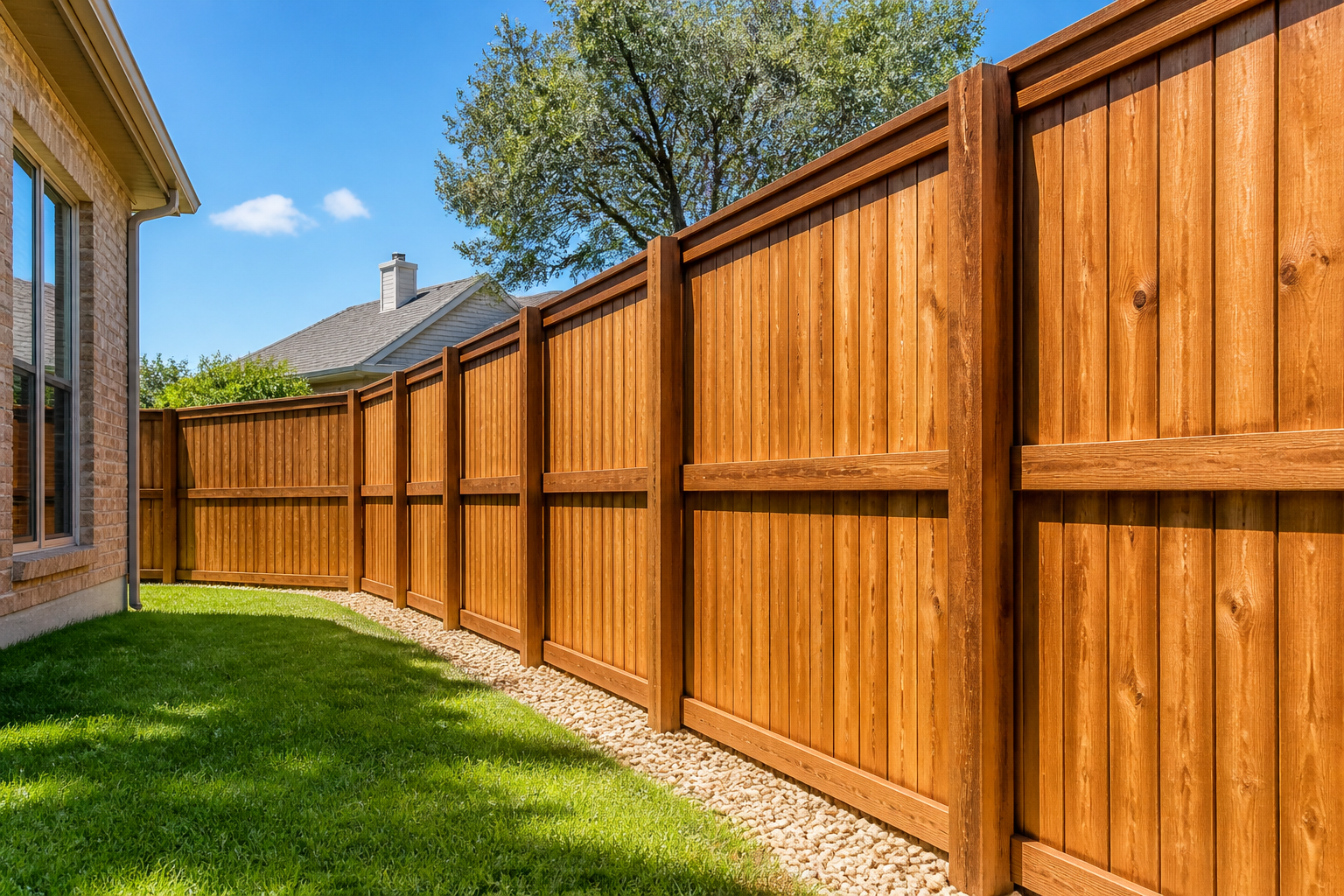
Why Wood Fences Take a Beating in South Texas
Most homeowners in Bexar County pay close attention to their decks, patios, and roofs. When wood begins to splinter on a deck board where people walk barefoot, the issue gets noticed right away. A backyard privacy fence, however, stands along the perimeter of the yard and rarely receives the same level of maintenance.
Yet that fence faces the exact same brutal environmental conditions day in and day out. In San Antonio, summer temperatures routinely push past triple digits, and direct ultraviolet (UV) radiation beats down on vertical pickets for twelve hours a day. When our prolonged dry spells suddenly break, they are often followed by torrential thunderstorms, hail, and high humidity.
Leaving wood bare against this cycle of intense heat, UV exposure, and moisture leads directly to warped boards, split rails, and rotting posts. Understanding how the local climate attacks wood structures helps clarify why wood fence sealing san antonio homeowners invest in is an essential part of regular exterior home care.
The Shared Threat: How Sun and Water Attack Wood
Wood is an organic, porous material. Whether it is installed horizontally on a deck surface or vertically on a privacy fence, it reacts to weather in the exact same manner.
Ultraviolet Degradation
Sunlight contains intense ultraviolet radiation that breaks down lignin, the natural glue that holds cellulose wood fibers together. When lignin degrades, the surface of the wood dries out, weakens, and loses its natural color. The dull, gray appearance typical of older San Antonio fences is not simply an aesthetic flaw; it is physical evidence that the wood fibers on the surface have died and separated.
The Moisture Cycle
Once the protective surface fibers break down, moisture penetrates the lumber much more deeply. In our region, weather patterns swing rapidly between bone-dry conditions and sudden cloudbursts. When bare wood gets soaked by rain, it swells. As the hot Texas sun emerges and bakes the fence dry, the wood contracts rapidly.
This continuous swelling and shrinking cycle creates structural tension across every board. Over time, that movement leads to:
- Surface cracking and deep splitting (known as checking)
- Cupping and twisting of vertical pickets
- Loosening of nails, screws, and brackets
- Moisture pooling inside micro-fissures, promoting mold and rot
Fungal Growth and Soil Contact
Unlike decks, which are generally elevated on concrete footings or posts, fence pickets frequently sit near or directly against the soil and turf. Lawn irrigation heads spray them multiple times a week, creating an ideal breeding ground for mildew, algae, and wood-destroying fungi. When damp pickets are shaded by trees or neighboring structures, the wood never fully dries out between waterings, accelerating decay from the bottom up.
Why Fence Maintenance Is Often Overlooked
Homeowners walk on their decks, host dinners on their patios, and park in front of their garages. Because fences sit at the margins of daily activity, problems tend to go unnoticed until an entire panel leans over after a thunderstorm or a post rots through at the base.
Replacing a residential cedar or pine fence is a major construction project. With the cost of lumber, metal posts, concrete, and labor, full fence replacement can quickly cost thousands of dollars. Inspecting your perimeter fence alongside other seasonal chores—such as checking your roof or scheduling concrete sealing—ensures that minor surface wear does not escalate into structural failure.
Taking care of the fence you already have through regular cleaning and sealing preserves your boundary, maintains your privacy, and avoids the disruption of digging up post holes and rebuilding sections from scratch.
How Wood Treatment Protects Vertical Surfaces
A specialized wood treatment works by penetrating deep into the cellular structure of the lumber rather than simply sitting on top like a film or latex paint. Surface paints frequently bubble, peel, and trap water inside the wood when applied to exterior fences in Texas. In contrast, penetrating treatments preserve the grain and allow the wood to breathe while repelling liquid moisture.
Blocking Moisture Intrusion
A high-quality penetrating seal keeps rainwater and sprinkler spray from soaking into the pickets and cross rails. Water beads on the treated surface and rolls off, preventing the dramatic swell-and-shrink cycle that cracks boards.
Filtering Ultraviolet Rays
Pigments and UV inhibitors in the treatment shield the wood from the harsh South Texas sun. By filtering out damaging rays, the treatment protects the natural lignin, helping the pickets hold their shape and keep their rich, natural appearance.
Extended Service Life
Applying a dedicated wood treatment can extend the life of your wooden surfaces for up to 5 years before another application is needed. Specific details regarding product characteristics, environmental profiles, and dry times are discussed thoroughly during the initial free estimate so homeowners can make an informed choice for their specific yard.
Preparing the Surface: Why Cleaning Comes First
You cannot apply a protective treatment over gray oxidation, mildew, or ground-in dirt. If a sealant is sprayed over dirty wood, it bonds to the grime rather than the lumber, resulting in uneven coverage and early product failure.
The restoration process always starts with professional surface preparation. Using exterior cleaning and pressure washing, our technicians remove accumulated mildew, algae, dirt, and dead surface fibers. Cleaning is purely a restorative step that prepares the surface; it strips away the contaminants that prevent deep absorption.
Once the wood has been properly washed and dried, the treatment can sink into the open grain evenly, creating a uniform barrier against the elements. You can view examples of restored and sealed wood surfaces in our project gallery to see the difference proper preparation makes.
What to Inspect on Your Fence Today
Before deciding whether your fence is a candidate for sealing, walk your property line and inspect the condition of the lumber. Here are four key signs that your fence requires attention:
- Water absorption: Splash a few drops of water onto a picket. If the water soaks in immediately and turns the wood dark, your fence has lost its protective barrier and is absorbing moisture.
- Color change: A weathered, gray, or bleached look indicates heavy UV damage to the surface fibers.
- Loose hardware: Pickets that rattle or pull away from the rails are experiencing the effects of seasonal warping and shrinking.
- Ground-level softening: Press a flathead screwdriver gently near the bottom of pickets close to the dirt or grass. If the wood feels soft, spongy, or damp, rot is beginning to set in.
Catching these signs early means you can wash and seal the wood before boards cup beyond repair or posts lose their structural stability.
Honest Surface Care for San Antonio Homes
At Lone Star Roof Rejuvenation and Surface Protection, we are a Marine Corps veteran owned company dedicated to providing direct, reliable solutions for local homeowners. We evaluate each fence honestly, looking at the wood species, age, exposure level, and existing wear to recommend practical maintenance that delivers long-term results.
Common Questions
- How long does a wood fence treatment last in San Antonio?
- A dedicated wood treatment can protect vertical fence pickets and rails for up to 5 years depending on sun exposure and irrigation patterns.
- Can weathered, gray fence pickets be treated?
- Yes. Graying is caused by dead surface fibers broken down by UV rays. Through professional exterior cleaning, those dead fibers and accumulated mildew are removed, exposing clean wood ready to absorb a protective treatment.
- Why shouldn't I just paint my wood fence?
- Exterior paint creates a hard film on the surface of the wood. In the Texas heat, paint often cracks, chips, and traps trapped moisture inside the board, which accelerates internal wood rot. Penetrating treatments allow the wood to breathe while repelling water.
- Are your wood treatment products safe for nearby plants and grass?
- All product safety details, plant protection procedures, and dry times are reviewed directly with the homeowner during the free estimate.