Your Roof vs. the Texas Sun
If you're a homeowner in San Antonio, you know the signs. You see those little colored granules—like coarse sand—collecting in your gutters or on your driveway after a rainstorm. You look up at your roof and it just doesn't have the rich color it used to. It looks dry, tired, and brittle.
That's the relentless Texas sun at work. The intense heat and UV radiation bake the essential oils right out of your asphalt shingles. Over time, this causes them to become stiff, weak, and unable to hold onto their protective granules. This is the beginning of the end for most roofs, often leading to an expensive and disruptive full replacement.
But what if there was a way to turn back the clock on that aging process? That's exactly what roof rejuvenation is designed to do. This isn't a gimmick or a temporary paint job; it's a science-backed treatment that works from the inside out. In this article, we'll explain in plain English exactly what is roof rejuvenation and how our nano-silica technology brings aging shingles back to life.
What is Roof Rejuvenation, Exactly?
At its core, roof rejuvenation is a process that restores the flexibility and performance of aging asphalt shingles. Think of it less like a coat of paint and more like a deep conditioning treatment for your roof. Instead of covering up the problem, it penetrates the shingle to address the root cause of aging: the loss of petrochemical oils.
When shingles are manufactured, the asphalt is saturated with these oils. This keeps them pliable, waterproof, and sticky enough to hold onto the top layer of ceramic granules. As those oils evaporate over the years, the shingle becomes as brittle as a dry leaf. Our job is to replenish what the sun has taken away.
We apply a scientifically formulated, all-natural treatment that soaks deep into the asphalt. This process re-saturates the shingle, restores its flexibility, and dramatically improves its ability to withstand the elements. It’s a way to potentially get more service life from your existing roof, saving you thousands compared to a premature replacement.
The Science Made Simple: How Nano-Silica Works
To understand the solution, you first have to understand the problem on a shingle-by-shingle level.
The Anatomy of an Aging Shingle
A standard asphalt shingle has three main parts:
- A Fiberglass Mat: This is the base layer that provides structural integrity.
- Asphalt: This thick, waterproof layer saturates the mat and acts as the adhesive.
- Granules: This top layer of tiny ceramic and mineral pieces serves as a shingle's armor. They protect the asphalt from direct UV exposure and physical damage from hail and debris.
The asphalt layer is the key player here. When it's healthy, it’s flexible. It can expand in the blistering San Antonio heat and contract during a cool front without issue. But as UV rays and heat bake it year after year, the oils within the asphalt break down and evaporate. The asphalt shrinks and becomes brittle.
This brittleness causes two major problems:
- Cracking: The shingle can no longer flex, so it starts to crack under stress.
- Granule Loss: The shrunken, hardened asphalt loses its grip on the granules. Wind and rain easily wash them away, exposing the vulnerable asphalt layer underneath. This creates a vicious cycle, as the exposed asphalt degrades even faster.
The Solution: Tiny Particles, Big Impact
This is where nano-silica technology comes in. Our treatment is a water-based emulsion containing microscopic particles of silica. When we say "nano," we mean incredibly, almost unimaginably small. These particles are so tiny they can penetrate materials where larger molecules can't.
When we apply the treatment with a gentle, low-pressure spray, it doesn't just sit on the surface. The nano-silica particles, carried by the bio-based solution, are absorbed directly into the pores of the aging asphalt shingle. They travel deep into the asphalt layer, going right to the source of the problem.
This is the fundamental difference between true roof rejuvenation and a simple roof coating. Coatings form a film on top, which can trap moisture and fail over time. Our treatment becomes part of the shingle itself.
Restoring Flexibility and Adhesion
Once inside the shingle, the nano-silica treatment works its magic. It replenishes the dried-out asphalt with a bio-based oil, restoring the chemical bonds that provide flexibility. The shingle regains its ability to bend and move without cracking.
Just as importantly, this process rejuvenates the asphalt's adhesive properties. It becomes sticky again. This renewed grip allows the shingle to lock its remaining granules back in place, drastically reducing further loss. This single benefit is critical to extending the life of your roof, as the granules are its first and most important line of defense.
The Real-World Benefits for Your Home
Understanding the science is one thing, but what does it actually mean for you as a homeowner?
- Stops Excessive Granule Loss: You'll see a noticeable reduction in granules in your gutters. This is proof that the treatment is working and your shingles are better protected.
- Improves Weather Resistance: A flexible shingle is a durable shingle. It's far better prepared to handle the hail, high winds, and torrential rains that are a fact of life in Texas. Brittle shingles are much more likely to sustain damage during a storm.
- Extends Your Roof’s Service Life: By restoring your shingles to a more flexible and durable state, you slow the aging process to a crawl. A single treatment can add up to five years of life to your roof. The process can be repeated every five years to potentially add up to 15 years in total, pushing a full replacement far into the future.
- A Smarter, Greener Choice: Every year, millions of tons of old shingles are torn off roofs and dumped in landfills. By rejuvenating your roof instead of replacing it, you're making a more sustainable and responsible choice.
What Roof Rejuvenation Is NOT
It's important to have clear expectations. Our treatment is powerful, but it's not a miracle cure for every roof problem.
- It is not a substitute for major repairs. If your roof is actively leaking, has extensive storm damage, missing shingles, or soft, rotting decking, those issues must be addressed first by a qualified roofer. Rejuvenation is for a roof that is aging but still structurally sound.
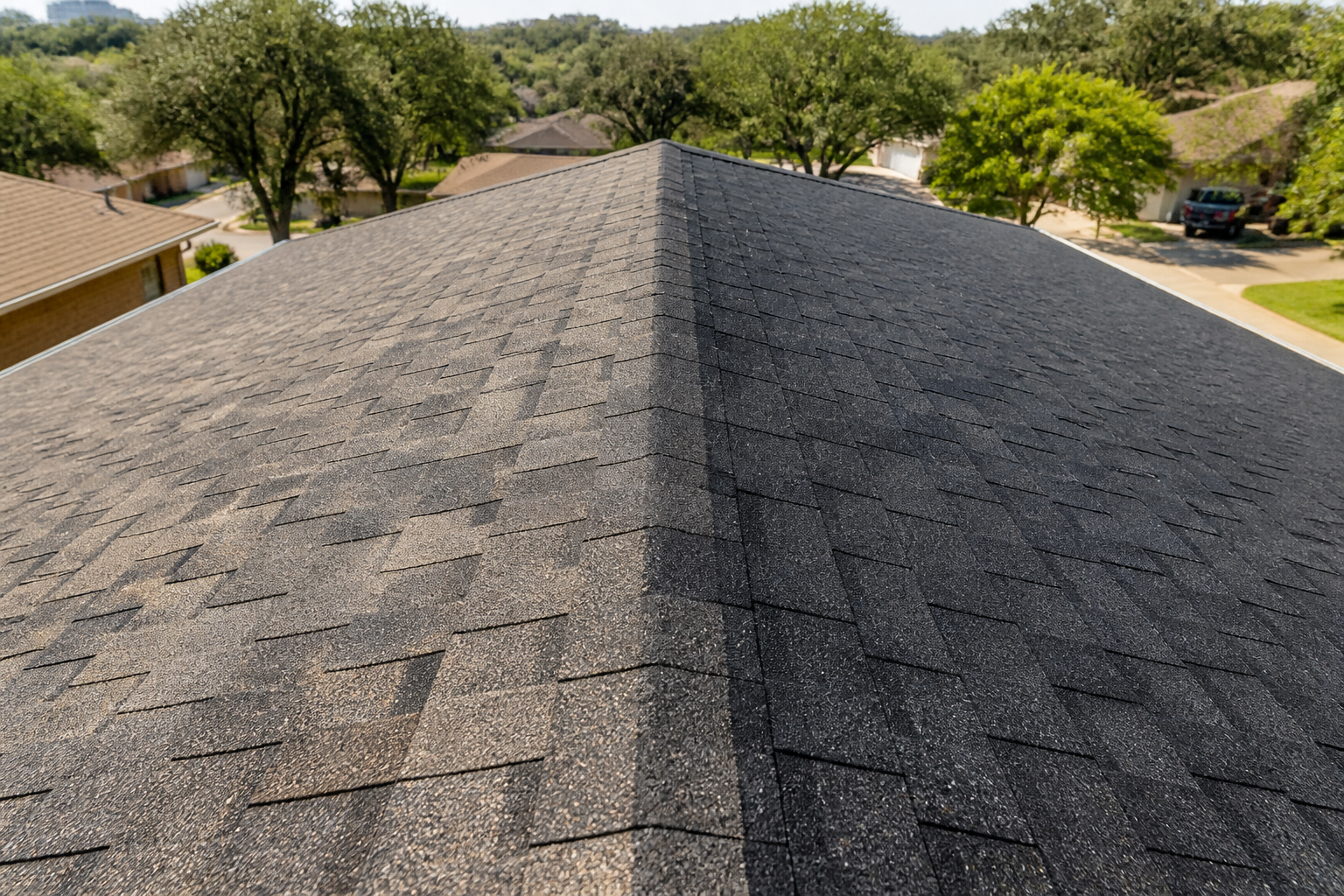
- It is not a paint or a thick coating. Our treatment is a clear, penetrating sealer. It won't dramatically change your roof's color, though it often restores a deeper, richer tone, making it look newer. It soaks in, rather than forming a film on top.
- It is not just a cleaning service. While a clean surface is necessary for the treatment to work, our exterior cleaning service is a separate step. The rejuvenation itself is a protective, restorative process that goes far beyond just washing away dirt and algae.
Common Questions
- Is the roof rejuvenation treatment safe for my family, pets, and plants?
- Yes. The treatment is a water-based, non-toxic, and all-natural food-grade product. We take precautions to protect your home and landscaping during application, but the product itself is safe for people, pets, and plants.
- Will roof rejuvenation change the color of my shingles?
- The treatment is clear and won't change the shingle's color, but it does tend to restore a deeper, richer appearance, similar to how they looked when they were newer. It gets rid of the 'faded' look of an old roof.
- How do I know if my roof is a good candidate for rejuvenation?
- An asphalt shingle roof that is 7-25 years old and showing signs of aging—like granule loss, dryness, or minor cracking—but is otherwise in good structural shape is an ideal candidate. The best way to know for sure is to schedule a free, no-obligation assessment with us.
- How long does the application process take?
- For an average-sized residential roof in the San Antonio area, the entire process is typically completed in just a few hours. It's significantly faster and less disruptive than a multi-day roof replacement.